
How to Get Better at Escape Rooms, From Behind the Glass

Here’s the thing. After watching thousands of games run from our
control room, I can usually tell in the first five minutes which teams
are getting out. And it’s almost never about brains.
You want to get better at escape rooms? Search the whole room before
you touch a single puzzle. Say every clue out loud the second you find
it. Put one person on the clock. Ask for a hint before you hit a wall,
not after. That’s it. That’s the whole secret, honestly.
Do those four things and your escape rate jumps. I’ve watched it
happen from behind the glass more times than I can count.
The rest of this is the how. Your first five minutes, the habits that
actually move the needle, and how to pick a room that fits your crew.
Stick with me.
How to Improve Your
Escape Room Skills
Skill in one of these rooms looks less like genius and more like a
team that talks. The best escape room strategy is honestly kind of
boring: a handful of habits, run under pressure. Here’s what the sharp
ones do differently.
Search the whole room first
Before anyone solves anything, sweep the place. Open every drawer.
Empty every container. Run a hand under the tables, behind the frames,
along the shelves. Found something that won’t open yet? Note it and move
on.
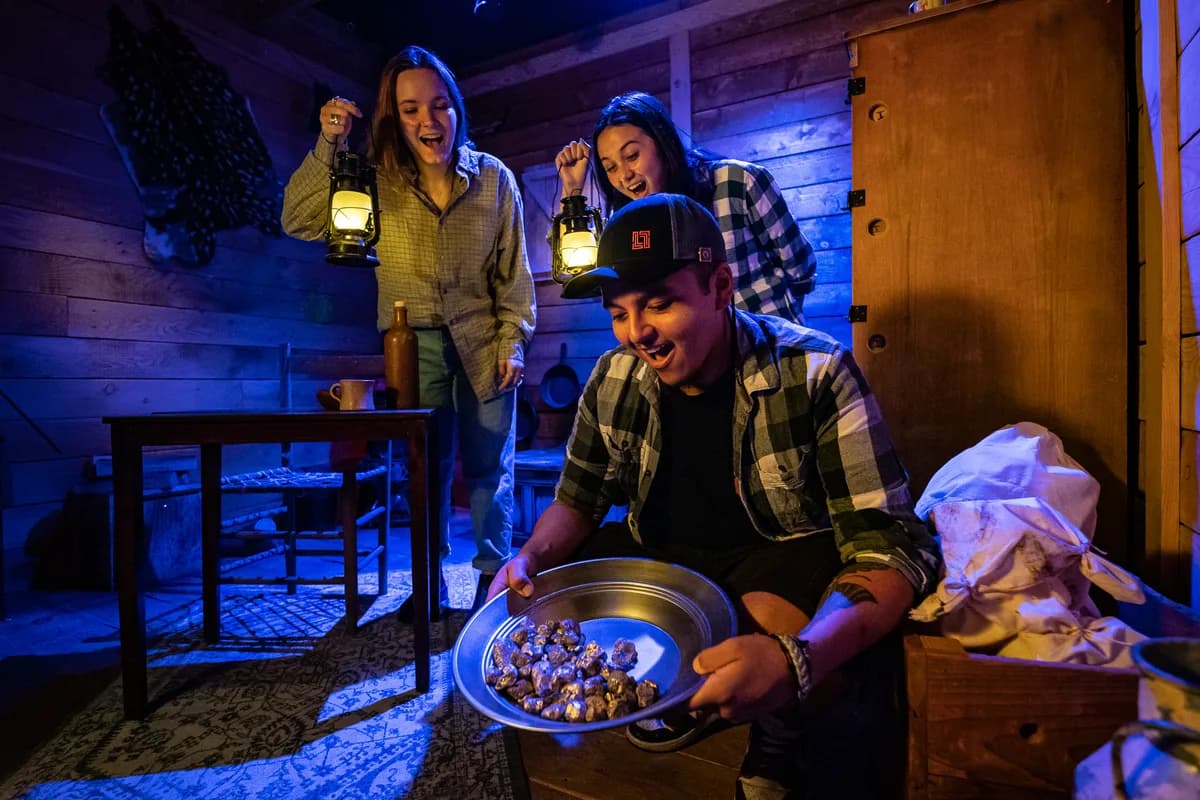
In a room like The Lost Mine, half your early progress is just
finding the lanterns and crates that hold the first clues. Two minutes
of real searching saves you ten minutes of guessing.
Search first. Always.

Say everything out loud
Call out every object, every number, every scrap that looks like
junk. Especially the junk. The teammate across the room might be holding
the other half of it.
A four-digit code is nothing on its own. Paired with the padlock
someone else just spotted? Now it opens a drawer. Silence is how good
clues die.
Give one person the clue
pile
Pick someone to gather the found-but-not-yet-used stuff in one place.
A table. A shelf. Somewhere everyone knows to look.
When a lock finally needs the key you picked up six minutes ago,
you’ll want to know exactly where it went. Scattered clues are the
number one reason teams re-search a room they already cleared.
Put one person on the clock
Give someone the timer. Their whole job is to watch it and call it
out. Halfway there. Twenty minutes. Ten.
At the midpoint, take ten seconds to regroup and count what’s still
shut. Teams that ignore the clock usually notice it only when the last
five minutes start flashing red. And that’s the exact moment clear
thinking falls apart.
Split up and work in pairs
Six people around one padlock is six people solving nothing. Break
into pairs. Spread out. Different puzzles, at the same time.
Finish one? Call it out and grab the next open thread. That’s how
momentum builds instead of stalling.
Stop forcing a lock after
three tries
Code failed three times? It’s the wrong code, or the wrong lock.
Simple as that.
So stop jamming the same numbers in. Set the clue down, work
something else, and come back with fresh eyes. Wrestling a lock that
isn’t ready is time you don’t get back.
Ask for hints early
Hints are part of the game. They’re not a mark against you, and I
mean it.
We’re watching the whole session. When we see a team stall for two or
three minutes, we’re already reaching for the nudge. The best teams ask
for it right then, not after ten minutes of spinning in circles. Used
well, a hint keeps the pace up and the room fun. That’s the entire point
of us being back there.
Retire a puzzle once it’s
solved
Lock opens? Push that puzzle aside. Leave the drawer hanging open.
It’s a small signal that says done, don’t touch.
Teams lose real minutes re-solving something they already cracked,
all because nobody marked it finished.
How to
Start an Escape Room (Your First Five Minutes)
How you start sets the tone for the whole hour.
Listen to your game master’s briefing. All of it. We’re usually
telling you your goal and the rules that actually matter, and half of
teams tune it out. Then, once the clock starts, do the full search
before anyone tries to solve a thing. Sort what you find into that pile.
Start with the easiest obvious puzzle you can spot.
Get one lock open early. That first click does more for a team’s
morale than any pep talk I could give you.
New to all of this? Our guide on how escape rooms work walks through a
session start to finish, and how to prepare for an
escape room covers what to sort out before you show up.
Escape Room Tips for
Beginners
You don’t need to be a puzzle genius. Really.
Clear communication beats raw brainpower almost every time, and I’ll
die on that hill. Talk constantly. Look carefully. Stay calm when
something doesn’t click right away, because it won’t at first, and
that’s completely normal.
Some of the best solves I’ve watched came from the quietest person in
the group noticing one small thing everyone else walked past. So give
everyone room to speak up. And remember, we’ve got eyes on the room the
whole time. Stuck? A hint is one question away. Nobody gets left
spinning with no way forward. The puzzles are clever. They aren’t out to
get you.
Bringing kids? Escape rooms are a great family pick, and younger
players catch details the adults blow right past. Any player under 13
needs a participating adult in the room with them, which honestly works
out great. Parents make excellent clue-keepers. Start the whole crew in
an easier room and you’ll spend the hour cheering each other on instead
of watching the clock in silence.
How to Pick the Right
Room for Your Group
Matching the room to your group is the difference between a great
night and a frustrating one.
First-timers do best in an easier room, where the wins come steady.
Veterans want something that pushes back. And size matters. Most of our
rooms fit teams of six to eight, and Excalibur in Nampa stretches all
the way to 12, so a big crew stays together instead of splitting across
two bookings. One room, one party, all the energy in the same place.
Here’s a quick way to choose.

| If your group is… | Try this challenge level | Good Labyrinth picks |
|---|---|---|
| First-timers or families | Easy (about 2 / 5) | The Lost Mine (Boise), Excalibur (Nampa) |
| Some experience | Accessible to Moderate (about 2.5 / 5) | Dead Man’s Chest (Boise), Tomb of the Pharaohs (both), Shipwrecked (Nampa) |
| Confident, done a few | Challenging (about 4 / 5) | Ragnarok (Boise), The Eternity Experiment (Boise) |
| Escape-room veterans | Expert (about 4.5 / 5) | Sherlock Holmes and the Doomsday Device (Nampa), our hardest room |
First time out? Start with The Lost
Mine, a great first room in Boise, or Excalibur, our beginner-friendly Nampa
room, which fits groups of up to 12. Done a few and want to be
pushed? Try Ragnarok if you want a real
challenge, a 75-minute room built for confident teams. And if your
crew eats hard rooms for breakfast, well, Sherlock Holmes and the
Doomsday Device, our hardest room is the one to beat. Rooms start at
$38.99 per person, and you can see current
pricing for live rates at both locations.
Common Mistakes That
Cost You the Clock
Most lost games come down to the same short list. Watch for
these:
- Jumping into the first puzzle you see before the room is
searched. - Sitting on a clue in silence because it looks useless.
- Six people, one padlock, zero progress.
- Punching the same wrong code in again and again.
- Saving your hints until the last two minutes.
- Re-solving a lock you already opened because nobody set it
aside.

Fix those six and you’ll shave real minutes off your run. Trust me on
that one.
Ready to Put These Tips to
Work?
Pick a room that fits your group and book a session at our Boise escape rooms or our Nampa
escape rooms.
Search first. Talk it out. Watch the clock. Ask for that hint before
you stall.
We’ll see you on the other side of the door. The countdown is
waiting.
Frequently Asked Questions
Frequently AskedQuestions, answered
Search the whole room before you solve anything, call out every clue you find, put one person on the clock, split into pairs on different puzzles, and ask for a hint before you’re truly stuck. Those habits raise your escape rate more than being “smart.”

Related articles
Is There an Escape Room Age Limit? A Parent’s Age Guide for Boise & Nampa
What age can kids do an escape room? Minimum ages for every Labyrinth room in Boise & Nampa, plus the best...

The Future of Escape Rooms in Boise Is Already Here
The Future of Escape Rooms in Boise: What’s Coming and Why It Matters Boise has outgrown the novelty phase of escape...
How to Prepare for an Escape Room
Get ready to beat the clock. Learn simple, smart ways to prepare for an escape room in Boise, from teamwork tips to...